
Flagstaff Property Tax Records
Flagstaff property tax records are kept by Coconino County, not the city. The county assessor sets values on all Flagstaff parcels each year. The county treasurer sends out tax bills and takes payments. You can search Flagstaff property tax records online through the Coconino County EagleWeb portal at no cost. Type in an address, owner name, or parcel number to see assessed values, amounts due, and payment history. The city of Flagstaff sets its own tax rates for city services, but billing and collection runs through the county. With more than 75,000 residents, Flagstaff is the largest city in northern Arizona and serves as the Coconino County seat.
Flagstaff Property Tax Quick Facts
Flagstaff Property Taxes Through Coconino County
The City of Flagstaff does not collect property taxes on its own. All Flagstaff property tax records are kept by Coconino County. The county assessor finds and values every parcel in the city. The county treasurer sends your bill and takes your payment. This is how all Arizona cities work. No city in the state runs its own property tax system.
When you pay your Flagstaff property taxes, the money gets split up. Part goes to the city. Part goes to the school district. Part goes to the county and state. Other local districts like fire and flood control may get shares too. Your tax bill lists every district that taxes your parcel. It shows the rate for each one and how much you owe to each. The city portion funds services like roads, parks, and other city needs. But all billing flows through the county.
Flagstaff sits at high elevation in the ponderosa pines. It serves as the county seat, so both the Coconino County Assessor and Treasurer offices are right in town. You can visit them in person or use their online tools. Either way, you deal with the county for any Flagstaff property tax record.
Flagstaff Property Tax Rates
The City of Flagstaff sets its own tax rates each year. These rates apply to property within city limits on top of county, school, and state rates. The city posts its current rates on the official Flagstaff Tax Rate Chart page. You can see how rates have changed over time and what the current figures look like.
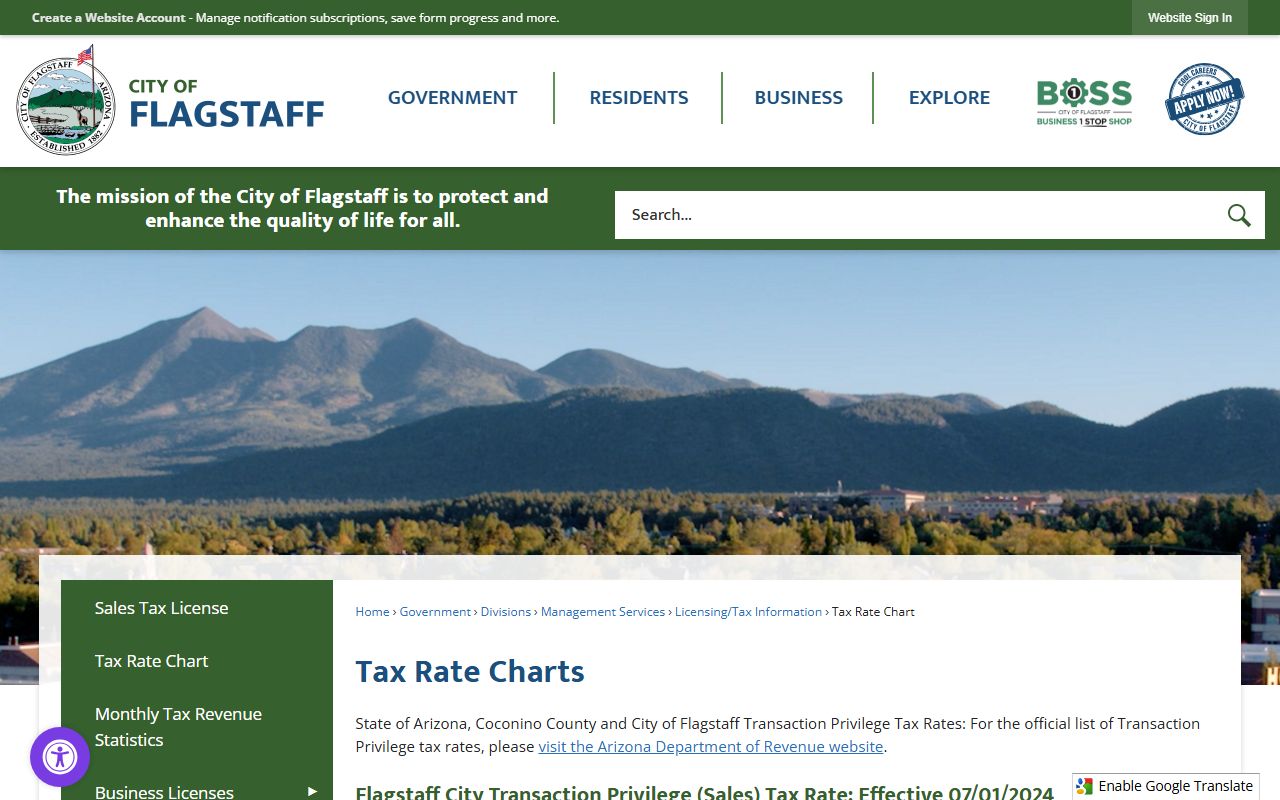
The tax rate chart shows both transaction privilege (sales) tax rates and property tax rates. For property taxes, the rate is expressed per $100 of assessed value. Your assessed value is 10% of your Limited Property Value for residential property. So if your home has a Limited Property Value of $400,000, your assessed value is $40,000. Multiply that by the rate per $100 to find the city portion of your tax bill.
Different areas within Flagstaff may have different total rates. It depends on which school district, fire district, and other special districts serve your parcel. The city rate is just one part of your total bill. Check your actual tax statement to see the full breakdown for your specific property.
Search Flagstaff Property Tax Records Online
Coconino County uses the EagleWeb system for online property searches. This tool lets you find any parcel in Flagstaff by address, owner name, or parcel number. The Coconino County Property Search portal shows tax amounts, payment status, and property details. Use it any time from your home computer or phone. No login is needed for basic searches.
The online system shows current and past tax bills. You can see if taxes are paid or past due. Property details include the assessed value, legal description, lot size, and building info. Some data comes from the assessor side. Other records come from the treasurer. The two offices work together to give you a full picture of any Flagstaff property.
If you cannot find what you need online, call the county offices. They can pull up records and answer questions. For official copies, you may need to request them in person or by mail. The offices charge small fees for some document types.
Coconino County Assessor for Flagstaff
The Coconino County Assessor values all Flagstaff property each year. Armando Ruiz serves as the county assessor. His office mails a Notice of Value each February. This notice shows your Full Cash Value and Limited Property Value. The Limited Property Value is used to figure your tax bill. Under Arizona law, it can only go up 5% per year.
Contact the assessor at 110 E. Cherry Ave in Flagstaff. The phone number is (928) 679-7962. Office hours run Monday through Friday from 8 a.m. to 5 p.m. Staff can help you understand your property value. They can pull records on any parcel. You can also sign up for electronic notices on their website to get your value notice faster.
The assessor tracks building details, lot size, and sales data for every parcel. This info helps set market values. If your home sold recently, that sale price becomes part of the public record. The assessor uses sales data from across the county to set values for similar homes.
Coconino County Treasurer for Flagstaff Taxes
The Coconino County Treasurer handles all property tax collection for Flagstaff. They send out tax bills each September. Bills are due in two halves. The first half is due October 1. It goes delinquent if not paid by November 1 at 5 p.m. The second half is due March 1 and turns delinquent after May 1 at 5 p.m. You can pay the full year by December 31 to avoid splitting payments.
Call the treasurer at (928) 679-8188 with billing questions. The toll-free line is 1-877-500-1818. You can also email treasurer@coconino.az.gov for help. The treasurer's office is at 110 E. Cherry Ave in Flagstaff, right next to the assessor. Both offices are in the same building, making it easy to handle all property tax matters in one trip.
Payment options include online, by mail, by phone, or in person. The office accepts credit cards, debit cards, and electronic checks through GovPros. Card payments carry a small fee. Once taxes go delinquent, interest starts at 16% per year. That works out to about $133 per month for every $10,000 owed. Pay on time to avoid these extra costs.
Note: The treasurer accepts card payments through GovPros with a processing fee added.
Flagstaff Property Tax Appeals
If you think your property value is too high, you can appeal. Start by filing with the Coconino County Assessor within 60 days of when the Notice of Value was mailed. The county mailed 2026 notices on February 11, 2025. Use ADOR Form 82130 for real property appeals. The assessor reviews your claim and may agree to lower the value.
If the assessor says no, you can take the next step. File with the County Board of Equalization within 25 days of that decision. The Arizona State Board of Equalization oversees this process statewide. They act as a neutral judge. You can also go straight to Tax Court within 60 days if you prefer that route.
Bring evidence to support your case. Sales of similar homes, repair costs, or photos of damage can help show why your value should drop. The board looks at facts and makes a ruling. Most appeals start with the county board because it costs less and moves faster than court. Keep track of deadlines since late filings get rejected.
Property Tax Exemptions in Flagstaff
Flagstaff residents may qualify for property tax exemptions through Coconino County. Veterans with a 100% service-connected disability can get a full exemption on their primary home. Under ARS 42-11111, this rule went into effect January 1, 2026. Other veterans with disability ratings may qualify for partial exemptions.
The Senior Freeze Program helps older homeowners on fixed incomes. If you meet the age and income rules, your property value gets locked for three years. Your taxes stay flat even if home prices rise. Apply through the county assessor using ADOR Form 82104. Widows, widowers, and people with total permanent disabilities can also claim exemptions.
Exemptions do not happen on their own. You must apply. Contact the Coconino County Assessor at (928) 679-7962 to find out if you qualify. Missing the deadline means waiting another year. Ask sooner rather than later if you think you might be eligible.
How Flagstaff Property Tax Bills Work
Your property tax bill depends on two things. First is the assessed value of your home or land. Second is the tax rate set by each district that serves your parcel. Schools, fire districts, the city, and the county all set their own rates. These add up to your total rate.
Arizona uses a Limited Property Value to calculate taxes. Under ARS 42-13301, this value can only rise 5% per year for most property. This rule keeps tax bills from jumping when home prices spike. Your Full Cash Value may go up faster to match market conditions, but your bill uses the limited value. The assessment ratio for homes is 10% of the Limited Property Value. So a home with a $350,000 limited value has an assessed value of $35,000.
The treasurer's bill shows each district that taxes your property. It lists the rate for each and what you owe. City of Flagstaff taxes are just one line item. School taxes often make up the largest share. The breakdown helps you see where your tax dollars go.
Contact Info for Flagstaff Property Tax Help
Both the Coconino County Assessor and Treasurer offices are in downtown Flagstaff. The address is 110 E. Cherry Ave, Flagstaff, AZ 86001. Visit in person during business hours to get help with your property tax records. Staff can pull up any Flagstaff parcel and explain values, bills, or payment options.
Key contact numbers for Flagstaff property tax questions:
- Coconino County Assessor: (928) 679-7962
- Coconino County Treasurer: (928) 679-8188
- Treasurer toll-free: 1-877-500-1818
- Treasurer email: treasurer@coconino.az.gov
- City of Flagstaff: 928-213-2000
Office hours are Monday through Friday, 8 a.m. to 5 p.m. The offices close on state holidays. If you cannot visit in person, use the phone, email, or online search tools. The county website has forms you can download and mail if needed. For city-specific questions about tax rates, contact the City of Flagstaff at 211 W Aspen Avenue.
Other Arizona Property Tax Resources
Flagstaff is the only city in Coconino County that meets the population threshold for its own page on this site. Other communities in the county include Page, Williams, Tusayan, and Sedona (which spans two counties). All of them use the same Coconino County offices for property tax records.
If you own property in other parts of Arizona, you may need to check records with a different county. To the east lies Navajo County with offices in Holbrook. To the south and west is Yavapai County with main offices in Prescott. Northwest of Coconino sits Mohave County based in Kingman. Each county has its own assessor and treasurer. Make sure you search the right county for the parcel you need. Coconino County handles all Flagstaff property tax records.